When Barack Obama became the 44th president of the United States of America, there was universal jubilation. Since the founding of the United States, all presidents were white Anglo-Saxon Protestants or Catholics. Even though America prides itself as a melting pot of culture and diversity, with its Hispanic and Black-American population comprising 20% and 14%, respectively, the white population has never entrusted the leadership of America to these cultural groups—until Barack Obama. Some contribute this to racism. However, given that democracy is driven by numbers, i.e., the ‘majority,’ the white population comprise the majority and the majority rules while those in the minority usually have their say as well through Congressional representation and party affiliation
It was therefore miraculous to have Barack Obama, whose ancestry is composed of white (America) (i.e., his Anglo-Saxon mother) and his Kenyan Luo (Nilotic) father. Many have expressed with awe that out of 250 years of American independence from British rule, it was a man with Kenyan heritage that was selected by the majority in America to map their future in 2009. The fact that Barack Obama was elected twice to be the president of United States erased a historical cultural bias that classified all white Americans as having a racist attitude towards every black person (even though ‘black’ and ‘white’ are not really races but are just a description of the outside skin color of a person since whites can be anything from Arabic to Eskimos and blacks can be any race and tribe of thousands from Africa and even the Caribbean and sometimes India, for instance). The common attitude was that Barack Obama was elected because he was qualified to be president. This also gave Kenyans a good reputation because they were seen to be composed of very intelligent people, which we are as a whole (even though we are 40+ tribal peoples with distinct cultures but one citizenship that binds us together—much like America’s multicultural mix).
It was therefore consistent with good for Kenyans to celebrate Obama’s rise to power by having fireworks, dancing, which created a sense of authority within international affairs. When Barack Obama came to Kenya in 2015, he was celebrated as the first president of the United States to visit Kenya. His visit was received with jubilation and celebration. He was given a welcome at the State House and millions of Kenyans. This was deserved.

However, it is important to note that many Kenyans, though celebrating ‘one of their own,’ were disappointed by Obama’s presidency. Kenyans were expecting President Obama to use his position to help Kenya financially and politically. Many Kenyans sharpened their knives and expected Obama to bring millions of cows to the poverty stricken areas of Kenya. The Luo community swept their roads and prepared firewood as they anticipated the flow of cow blood in every neighborhood, from Kisumu to Kogero to the deepest part of Luo Nyanza.
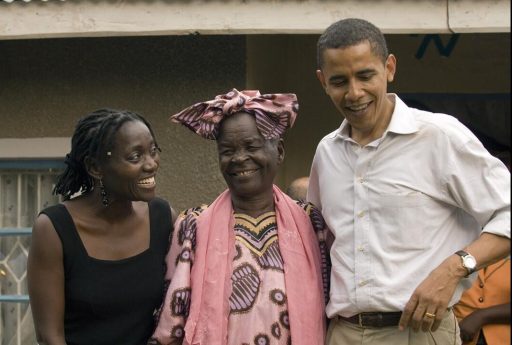
The natives were, however, disappointed and after a few years they began to return the clean knives and turn off the fires. There was no nyama choma coming from Obama’s America. Many began to say that the only good thing he brought Kenya was “Kizungu mingi”. Many tribes outside the Luo Nyanza began to joke that if Obama was to run for president in Kenya he would lose.
In Kenya there is a Swahili saying: “Mkono mtupu Haurabwi.” And the Kikuyu say, “CORO MAI” is not an empty proverb as it literally demands that people receive motivation to blow the trumpet. The questions they ask are: “How do we blow the trumpet without energy?” and “How do we run on an empty stomach?” To many, Obama was all talk—an empty “sufuria.” And to a large extent, they were not wrong. I happened to know Obama’’s family and even visited his gracious and wonderful grandmother in Kogero (see photos).
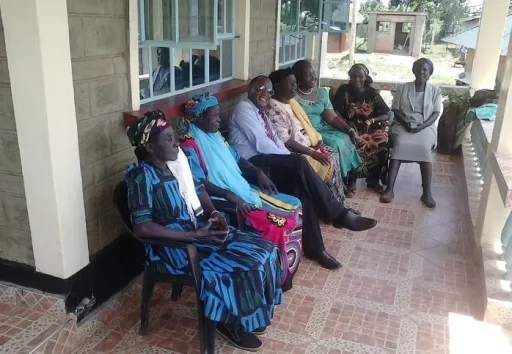
What I saw confirmed the tribal cries of “CORO MAI.” His family lived in poverty, and he had done nothing to improve his own homestead except tell people in Kisumu to get AIDS testing—that was the extent of his legacy in his people’s homeland.
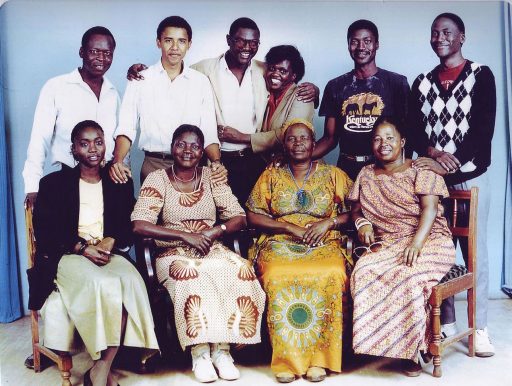
Therefore, the dreams and expectations of Kenyans for Barack Obama to help Kenya were as empty as the speculation that spread during his visit to Kenya. Many speculated in jubilation that he was the first U.S. president to visit Kenya. The truth is, he was not. And it will surprise you next week to learn who was the first U.S. president to visit Kenya. In fact, you will be shocked to learn what that president did for Kenya. Who was the first U.S. president to visit Kenya? Not Obama.
KIAMBU MAGAZINE GUEST COLUMNIST – Teddy Njoroge Kamau (PhD). Harriett’s Bluff, Kijabe, Kiambu County
###
Teddy Njoroge Kamau is a retired professor of Western Philosophy, Theology of St. Paul, and Anthropology. Also a retired scholar in Behavioral Psychology (research), Dr. Kamau authors a syndicated column in Diaspora Messenger and has served as a radio and television presenter with Biblia Husema Studios in Kijabe.